The Top Deck Is the Studio: A Field Guide to Car Park Portraits
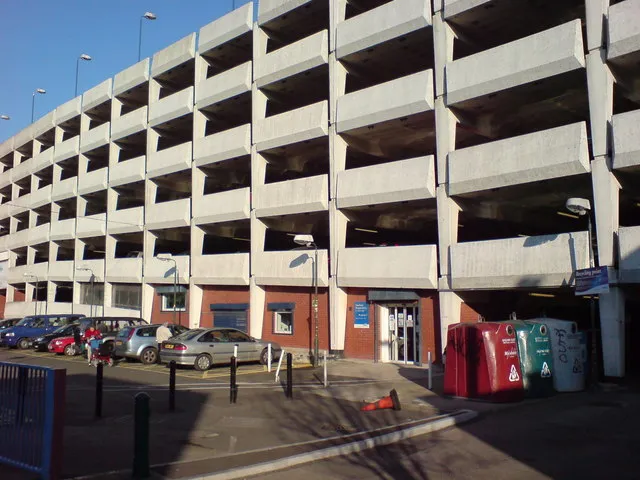
Photo: Danny Robinson, CC BY-SA 2.0, via Wikimedia Commons
Multi-storey car parks have a reputation problem. They are where you leave the car before the actual day begins, not where you make the photographs. That is exactly why they work. A UK town centre car park gives you clean lines, shelter from the weather, a top-deck skyline and enough concrete to make a portrait feel graphic rather than precious. For editorial clients and couples who want something less manicured, it is one of the most reliable sets in the country.
Why the car park works
The appeal is not irony. It is control. A car park is a controlled environment with edges, ramps, columns and repeated shapes. You can put a subject against a wall and get a hard, simple frame. You can use the long curve of a ramp as a leading line. You can stand on the top deck and borrow the whole town as a backdrop without asking a single tourist to move out of shot.
It also solves the British weather problem. Rain, wind and flat grey skies can ruin a location shoot, but a car park keeps working. The top deck gives you open air when the light is good. The stairwell gives you shelter when it is not. In 2026, with venue hire costs still squeezing editorial budgets, that flexibility matters.
Scout the light before the location
The first thing to check is not the view. It is the light. Walk the decks at the time of day you plan to shoot. A south-facing top deck will bake in summer and glare in winter. A north-facing deck may give you softer, more even light for faces. Stairwells often have a mix of daylight and fluorescent tubes, which can be ugly or useful depending on how you handle it.
Take a grey card or a white balance reference. Mixed lighting is normal in car parks, and skin tones can drift green under old fluorescent fittings. You do not need to make the space look clean and neutral. You do need to decide whether the colour cast is part of the picture or something to correct. A little green can feel institutional and atmospheric. Too much looks like a mistake.
The top deck as a skyline studio
The top deck is the obvious hero. Get there early or late enough to avoid the lunchtime rush, and look for a section with a clear parapet and a decent view of rooftops, church towers, chimney pots or retail park signage. UK town centres often have a messy skyline, and that is the point. It gives context without turning the portrait into a travel shot.
Use the low walls and railings as framing devices. Shoot through gaps. Put the subject close to the edge of frame and let the town fall away behind them. If the sky is flat, expose for the faces and let the background go bright. If the sky has shape, pull back and let the clouds do some work. A polarising filter can help with reflections on car windows and wet concrete, but do not overdo it. You want the place to feel real.
Stairwells, arrows and fluorescent light
Do not ignore the interior. Stairwells are where car parks become properly graphic. Painted arrows, bay markings, numbered columns and yellow line work all give you visual rhythm. Look for a stairwell with a window at one end and a long run of steps. The light will fall in a way that separates the subject from the wall.
Fluorescent strips can be used as practical light. Put the subject under a fitting and let the top of the frame fall dark. Use the repetition of ceiling lights as a background pattern. Avoid mixing flash and fluorescent unless you know exactly what you are doing, because the colour temperatures will fight. If you need flash, gel it or convert the frame to black and white and lean into the contrast.
A practical scouting checklist
Before you commit to a car park, visit it without a camera. Check the following:
- Access: can you walk in without a ticket, and are there pedestrian exits on each level?
- Light: where does daylight fall at your planned shoot time, and what colour are the artificial fittings?
- Background: what can you see from the top deck, and does it suit the story you are telling?
- Noise: is there a ventilation unit, lift motor or road that will make direction difficult?
- Cleanliness: are there stained walls, bins or oil patches that will need avoiding?
- Security: are there barriers, cameras or staff who will ask what you are doing?
- Weather: where will you shelter if it turns, and is the stairwell dry?
Permission, safety and being a good guest
A car park is private property, even when it feels public. For a small portrait shoot, you can often work quietly without fuss, but for anything with a crew, lights, a client and a changing screen, ask first. Council-run car parks and national operators usually have an office or contact centre. Explain what you are doing, keep the footprint small and avoid blocking bays or exits.
Safety is not boring. Cars move in car parks, and drivers do not expect a couple posed around a corner. Keep the party on pedestrian routes, use high-visibility clothing if you are near vehicle ramps and never pose anyone on a live roadway. If you are shooting at dusk, bring a small light for the walk back to the car. Be polite to attendants. They have seen every kind of shoot, and a friendly word goes further than a tripod planted in the middle of a turning circle.
Making ordinary infrastructure look deliberate
The car park becomes a set when you treat it like one. That means repeating shapes, choosing clean angles and editing with discipline. Do not include every arrow and sign in every frame. Pick one graphic idea per shot: a column, a ramp, a line of lights, a slice of skyline. Let the concrete be concrete. The moment you stop apologising for the location, the pictures get better.