No Chandeliers, No Problem: In Praise of the Village Hall Wedding
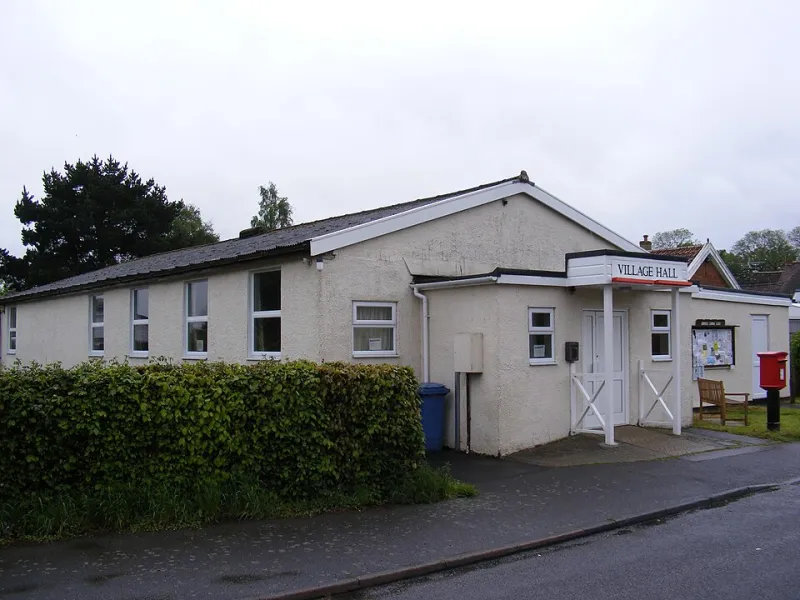
Photo: Geographer , CC BY-SA 2.0, via Wikimedia Commons
There is a particular kind of wedding photograph that only a village hall can give you. It is not the confetti shot. It is not the first dance. It is the moment a couple stands in a room that smells faintly of floor polish and tea urn steam, with a stack of folding chairs behind them and a handwritten sign on the door, and they look completely at home. That is worth more than a marble staircase.
The room tells the truth
Country-house weddings are lovely. They are also designed to look like weddings. The architecture does half the work before the couple arrives, and the photographs can end up feeling like a brochure for the venue rather than a record of two people. A village hall does not do that. It gives you a plain room, a high ceiling, a stage maybe, a kitchen hatch and a noticeboard full of parish council minutes. It asks you to find the picture rather than borrow one.
That is not a criticism. It is the reason these spaces work. When a couple chooses a hall, they are usually choosing something local, affordable and personal. The room carries the fingerprints of the people who run it: the caretaker who knows where the extra chairs are, the aunt who has done the flowers, the friend who has rigged a playlist through a borrowed speaker. Those details are not clutter. They are the story.
Lighting that asks you to pay attention
Let us be honest about the light. Village halls are not blessed with flattering illumination. You will find fluorescent tubes, strip lights, a wall of windows at one end and a stage light that someone found in a cupboard. The colour temperature will be inconsistent. The ceiling may be low. The walls may be cream, magnolia or a shade of green that only exists in community buildings.
None of that is a reason to avoid the venue. It is a reason to scout it properly. Visit at the same time of day as the wedding breakfast and the speeches. Find out where the windows fall. Decide whether you are going to work with the ambient light or bring your own. A simple off-camera light bounced into a corner can lift a face without making the room look like a studio. A white ceiling is a gift. A dark stage is a problem you can solve by moving two feet to the left.
The honest light is part of the appeal. A hall does not pretend to be a ballroom. If you expose for the room and let the windows blow out, you get atmosphere. If you underexpose the room and light the couple, you get a portrait that feels made rather than found. Both are valid. The mistake is trying to make a village hall look like a country house. It never works, and it misses the point.
Volunteer-run quirks are part of the set
I have shot in halls where the kitchen hatch became the bar, where the stage curtain was held open with a clothes peg, and where the heating made a noise like a distant aircraft. These are not inconveniences. They are the texture of the day. A couple signing the register on a folding table covered with a borrowed cloth is just as meaningful as a couple signing in a library with a fountain pen.
The quirks also make people relax. Guests know how to behave in a village hall. They move chairs, they queue for tea, they stand in the corridor because the main room is full. That informal choreography gives you candid moments you would never get in a venue with a event manager directing traffic. For portraits, it means you can pull the couple into the kitchen doorway, against the noticeboard, or onto the stage without it feeling like a production.
The portrait moments you cannot stage in a country house
Some of the best frames happen in the gaps. The couple walking back from the toilet block because the hall only has one. The groom carrying a tray of glasses through a side door. The bride sitting on a plastic chair while someone fixes her hem. These are not glamorous, but they are true. In a hall, the day is close enough to touch.
There is also the light in the evening. When the main room is lit by a mix of fairy lights and fluorescent strips, and the windows have gone dark, you get a warm, enclosed feeling that suits documentary portraits. Put the couple near a doorway with the outside light behind them and you get separation. Put them under a strip light and you get a hard, graphic look that feels surprisingly modern. A village hall is not a soft-focus venue. It is a place of edges, and edges can be beautiful.
What to look for when scouting a hall
If you are photographing a village hall wedding in 2026, ask for a site visit. Check the following:
- The main room: ceiling height, window direction, wall colour and whether the lights can be dimmed.
- The stage: is it usable, and does it give you a clean backdrop or a clutter problem?
- The kitchen: often the best candid light in the building, and a natural place for quiet portraits.
- The entrance: where guests arrive, where confetti happens and where the couple will walk in.
- The outside: a car park, a playing field or a bus stop can all be part of the set if you use them deliberately.
- The rules: halls often have curfews, noise limits and a volunteer caretaker who needs to lock up.
A quiet case for keeping it local
Village halls are not for every couple. They suit people who want a day that feels like their own, not a day that feels like a package. They suit couples who are happy to let the room be a room. And they suit photographers who are willing to look closely at ordinary things.
The country-house wedding will always have its place. But the village hall has something rarer: honesty. It gives you a plain room, a few quirks and a community of people who have turned up to make the day work. If you can photograph that without apologising for it, you have got something better than a chandelier.