Folded Tables, First Light: A Portrait Field Guide to the Sunday Car Boot
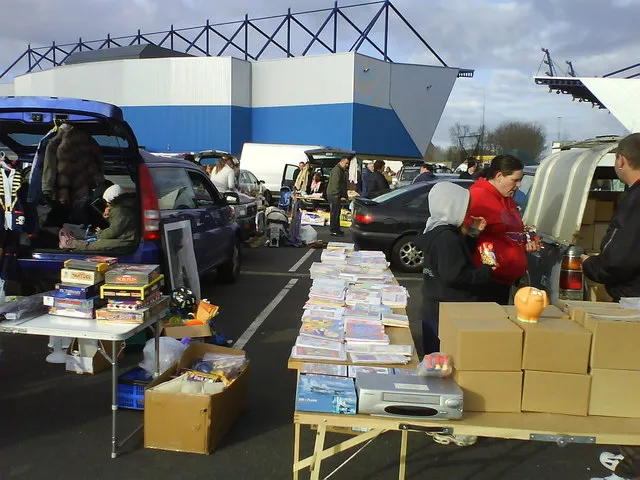
Photo: Steve Daniels, CC BY-SA 2.0, via Wikimedia Commons
At ten past seven on a Sunday, a rugby club car park is already a small town. The first sellers have backed their estates and vans into rows, unfolded the pasting tables, and started the serious business of laying out other people's treasures. Steam rises from a flask. Someone is arguing gently about a five-pound lamp. The light is low and horizontal, and if you stand still for a minute you can watch the whole British weekend ritual assemble itself around you.
I have been photographing car boot sales on and off for years, first as a curious local and later as a portrait photographer looking for sets with real texture. The last Sunday sales of 2026 are thinning out now, but the car boot will be back. It always is. And it remains one of the most generous places in the UK to make portraits, provided you treat it as a working market rather than a fancy-dress version of Britain.
Why the car boot earns its place in a portrait portfolio
Three things make it work. First, texture: tarpaulin, chrome bumpers, cardboard boxes, mismatched tablecloths, hand-written signs, the soft scuff of gravel underfoot. Second, occupied hands. People at a car boot are sorting, lifting, pricing, chatting and negotiating. That gives a portrait somewhere to live. Third, the light. An open field or car park at 8am gives you soft overcast or low sun that rakes across the stalls and picks out the edges of things.
The goods are not props, though. They belong to people. The moment you start arranging a stallholder's stock as if it were a styling kit, the picture goes false. Better to photograph the ritual as it is: the early birds, the folded tables, the bacon bap interval, the slow pack-down at noon. The car boot is not nostalgic. It is a live market, and in 2026 it is still full of character.
Scout the site like a location, not a shopping trip
Before you take a camera, check the organiser's listing and send a short message. Most UK car boot sales are run by parish councils, rugby clubs, schools or private promoters, and they appreciate knowing a photographer is coming. Ask where you can stand, whether there are restrictions around the stalls, and whether they would like a couple of images for their own use. That one email saves a lot of awkward conversations later.
Arrive before the public, but not so early that you are in the way of unloading. Walk the perimeter. Find three backgrounds you could use without blocking an aisle: a hedge or fence line, the side of a trailer or van, and a stretch of open asphalt with a bit of sky. Note where the tea van sits, where the toilets are, and where the generators and bins live so you can keep them out of frame. Check the sun direction. Car boots are usually in open fields or car parks, so you are working with whatever the morning gives you.
Also check the ground. Mud is part of the deal. Wear boots, bring a plastic bag to kneel on, and do not wear anything you would mind losing to a puddle. If it rains, look for tarpaulin roofs, umbrellas and the steam off a tea urn. Wet ground reflects light beautifully, and a damp November morning can be softer than a studio.
Pack light, pack useful
One camera body is enough. A 35mm or 50mm lens will cover most of what you need; an 85mm is useful if you want to compress the background and work a little further back. Leave the softbox at home. A car boot is not the place for a lighting assistant and a stand. You want to look like a person with a camera, not a production unit.
Bring spare batteries and keep them warm in a pocket. Pack a lens cloth, a small notebook or your phone for names, and a couple of plastic bags for kneeling. A collapsible reflector is optional. Most of the time a white van panel, a tarpaulin or the open sky will do the same job without any fuss. Buy a tea from the van. It helps you slow down, and it gives you a reason to stand still and watch how the market moves.
Ask first, and ask properly
The stallholder is at work. That is the first ethical fact of the car boot portrait. Ask before you photograph them, explain what the pictures are for, and offer to send a copy. If they want to know why, tell them: you are photographing a series about Sunday car boot sales and the people who make them happen. Show them a previous frame on your phone if it helps. If they say no, thank them and move on. There is always another stall.
For customers, ask them as well as the stallholder. For children, ask the guardian. Do not photograph tills, card readers or personal documents. Do not make a picture that laughs at someone, and do not frame a stall as a punchline. The best frames come from collaboration: the seller who holds up the object they are most proud of, the couple who start haggling over a chair they do not need, the bloke who tells you the story of a torch he has had since 1989.
If you plan to publish, get names and permissions. A simple note on your phone is enough: name, role, date, and what the image may be used for. It takes thirty seconds and it keeps the relationship honest.
Make the frame: goods as foreground, people as anchor
Start wide to establish the scene, then move in for a mid-shot, then look for a detail. For couples, give them a small task rather than a pose. Ask them to choose one object under a fiver that the other would hate, then carry it to the next stall and negotiate. You will get far better pictures of two people being themselves than two people pretending to be in a magazine.
Use the goods as foreground: crates, hanging clothes, the open hatch of a car, the edge of a pasting table. Shoot at f/4 if you want to keep the context readable; the background is the point. Watch for clean negative space. A hedge, a tarpaulin or a blank van side can give the eye somewhere to rest. Hands matter. Wait for the glance between a couple, or the moment a stallholder stops sorting and looks up.
Light, weather and the British morning
Overcast is a giant softbox, and it is your friend. Low sun is beautiful but it makes people squint, so put the sun behind your subject and use open sky or a white van as fill. Rain brings umbrellas, tarpaulin roofs and steam, all of which add atmosphere, but keep your gear dry. In November, shoot before ten; in July, start at half six. The car boot has its own clock. Early is best. By eleven the light is hard and the stalls are packing up.
Edit for dignity, not nostalgia
Do not choose only the rusty signs and enamel jugs. Include the people who are working, trading and chatting. Build a small sequence: the scene, a stallholder portrait, a couple frame, a detail, the exit. Caption with first names and roles if you have permission. Avoid heavy filters. The point is not to make the car boot look old. The point is to show it as alive, muddy and thoroughly British in 2026.